In the beginning
The first dog Rosanna considered to be “hers” actually was her father’s German Shepherd Dog, Fleasie. Rosanna was too young to really have dogs of her own, but she stepped up and took as much care of Fleasie as she could. As the years rolled by, other GSDs joined the family. Meanwhile, her father and her grandfather kept Dachshunds. The Daschunds would never give a little girl (or anyone) the time of day, but the GSDs were always ready to play.
When Rosanna and I got together, she had a rescued Labrador x Golden Retriever cross named Avatar. She often took Avatar to work and taught the children she was working with how to relate to dogs. Avatar loved hiking, playing, all things water, and, especially, eating. This dog never, ever passed by anything that might be food.


Back to the shepherd dogs

After Avatar, Rosanna was away at grad school, so we went through a period of doglessness. She felt the hole in our lives rather more keenly than I did. Unconsciously, she attempted to plug the gap by sculpting a snow dog in the backyard. I knew we’d be looking for a real dog soon.
And so it happened that we added a couple of well-bred, purebred GSDs to the household. We got the first of our German Shepherds, “Argos” Mrs. Argos Pinkerton, a truly magnificent black and red animal, from a breeder in Wolf Point, Montana. This dog was followed by “Freude” vom der Grossen Himmelland (pardon our bad deutschsprachig in naming her), an equally splendid black and tan GSD from the same breeder. These dogs were kind to children, always up for a game of fetch, and kept a good eye on things. Freude, especially, was fond of chasing porcupines. She provided a quantity of quills that Rosanna crafted into jewelry for her friends and herself.
Time to downsize dogs
Following the GSDs, a gorgeous, sensitive red Aussie with a well-known working heritage joined the family as a rescue. He was our starter dog introducing us to the wonderful world of Aussies. He was probably a bit too young when the first owners put him to work with some onery cattle, and he did not do well. In the end, they decided that he’d make a better pet than a working dog. They were right: Russel the red dog was an excellent member of our household.


Our “circus dog,” a young rescue Aussie-BC cross, came along bringing her athleticism and bag of circus tricks. She stayed with us until she was quite elderly, frail, and plagued by seizures. Her “sister,” a purebred but not particularly well-bred young Aussie rescue, also lived a good long life with us.
The one who stands out as different

Our list would not be complete without mentioning our Shiba Inu. She is purebred but is also a rescue. Her home fell apart, and we were able to apply to take her. We had to pass an interview with her breeder, and then we were able to arrange something like a bucket brigade of private pilots to fly her from the east coast to Billings for us. She was eight years old when we got her, and she needed quite a bit of veterinary care as soon as she arrived. I have to admit that Shibas are very different from any other dog we have had, and I would not describe Shibas as a good dog for a beginner.
The courtship with “Koko” Royal’s Koko King FDC CGC TKI has taken a long time. Coming, as she did from a situation where her owner in Miami shared custody of her with his father in Rhode Island, it took her an especially long time to decide that being with us was permanent for her. I think she worried that we were another set of custodians who had simply joined her circuit with yet another set of rules for her.
Now we are happy together, at last.
Captured by Lancashire Heeler dogs
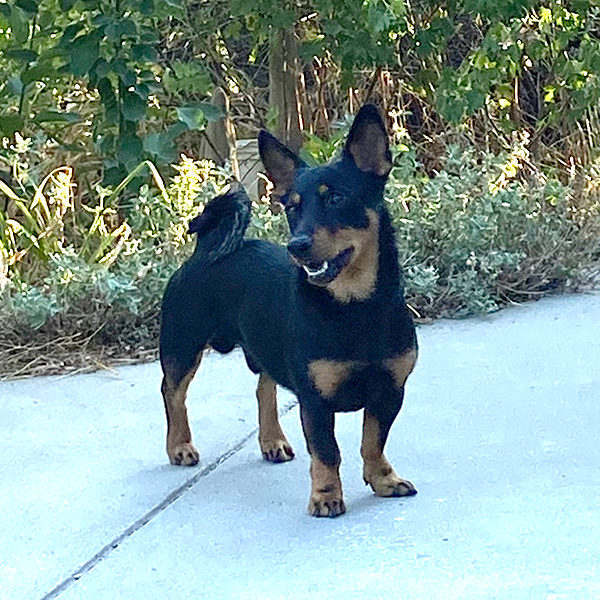
As our last Aussie was nearing the end of her life, we started thinking about what our next dog would be. We knew we wanted a smaller breed, but we knew we are not appreciative enough of the dogs in the toy group. We liked the personality types associated with herding dogs. A friend told us about Lancashire Heelers. We began studying the breed and joined the USLHC.
The gateway dog
Through the club, we learned that there was an older female that needed a home because her person had passed away unexpectedly. Rosanna quickly made arrangements to pick her up from San Diego. This gateway dog came into our lives, and that was it for us—Lancashire Heelers forever.
She was nearly 11 on the day that Lancashire Tobi became homeless. When she walked in our front door for the first time, it seemed that she instinctively and instantly knew that she belonged with us. There was no period of adjustment. She slipped into the family as though she’d always been here. Although she left this world all too soon, we had a great time together, and she picked up CGC and TKN titles.


A new dog joins the other dogs
We joined a waiting list for a Lancashire Heeler puppy from a respected breeder. Her dogs are very much in demand, and we would probably still be on a waiting list, but for the appearance of Covid (at least it was good for one thing). A puppy placement fell through because of the pandemic. We were able to use a flight nanny to pick up our puppy and deliver him to us in Billings.
The puppy, Prestige Berkeley Rufford RN FDC CGC TKI, became known as “Ruffy.” We gave him his kennel name, Prestige, added Berkeley (pronounced Bark-lee) because, you know, that’s what dogs do, and finished with Rufford, the name of a village in West Lancashire, England, a tip of our hat to his roots.
New adventures for us
The more we got to know our new little dog, the more we came to realize that we wanted more people to know about this breed. We discovered that the best way to introduce him was to become involved in competition and dog sports. Given his limited opportunities to compete against other Lancashire Heelers, he has done respectably well in the conformation ring with 6 CM points picked up after competing in Greeley, Colorado and Logan, Utah. He also has picked up a full wall of ribbons and several titles. He is beautiful, athletic, and charismatic. When we take him to events, we find that our Lancashire Heeler even has a fan club.


Currently, Ruffy is the only Lancashire Heeler we know of that exists in a geographic area about the size of Western Europe (North Dakota, South Dakota, Wyoming, Colorado, Idaho, and Montana).
So many wonderful dogs have entered and departed our lives. Now our home is filled by Ruffy, his Shiba-sister Koko, and his kitty Pekoe.
Our dogs of the feline persuasion
Although we already had a cat, we took in my sister’s cat, Raoul, a big, long-haired orange tabby. Raoul did not like us. To be perfectly frank, Raoul didn’t like anybody. After he bit my hand deeply enough to expose my tendons, I never touched him unless I wore welding gloves. He eventually decided that he preferred the life of a barn cat to that of a house cat. We didn’t try to dissuade him.
After we left the farm and moved into town, we were adopted by a handsome Siamese cat. Well, at first, we thought he had adopted us. As it turned out, it was our black dog, Avatar, whom he adopted. The two quickly became inseparable—playing, sleeping, eating, cuddling, and riding in the car together. Nick was inconsolable when his dog passed and mourned her for the rest of his life.
The brothers from a barn

Milton and Spenser were feral brothers who grew up in a barn before joining our household. Milton was a dilute gray marbled tabby, while Spenser was a mackerel tabby. We brought them home, released them into the house, and literally did not see these cats for at least two weeks. We say evidence in the food bowl and in the litter box, but neither hide nor hair of the actual cats. Later, we’d catch glimpses of them, but it was months before they truly accepted us. Eventually, they both became affectionate lap cats.
Old and needy

Roobee lived with us for a while. Her elderly owner was not able to care for her, so we agreed to take her in. Roobee herself was quite advanced in age. Her matted coat would respond to no remedy short of shaving. Plus, she needed extensive dental work. Rosanna made sure that Roobee got the care she needed and did her best to provide the kitty a welcoming home in which to live out her last days.
Pekoe, the orange dog, erm, cat

Now Pekoe, an 11-pound (5 kg) orange tabby, is the top cat again. We were his fourth placement when we adopted him at only six months of age. He has a marvelous purr, but he was not the cuddly, snuggly kitty most people seek. No, as a kitten, Pekoe was a bitey, scratchy kitty. How much of that attitude was brought on by the fact that he suffered from a hidden and rare infection in his gastrointestinal tract when we adopted him, we’ll never know. Now an adult with a healthy gut, he has tamed down considerably. He gladly sits in laps, weaves around our legs, puts up with the dogs, and even tolerates grooming his coat, brushing his teeth, and trimming his nails. He knows a few tricks, walks well on a leash, and comes when called by name (mostly).
A parade of others
The lamb
Although we mostly are dog people, with a dash of kitty, we have entertained a parade of other animals in our lives. Prime among these was the lamb. While we did not actually teach him to jump over a stick, we did pop him in the back of the hatchback with the black dog and take him to a family reunion. Along the way, we stopped at a rural gas station when a fellow inquired about the big fluffy-looking dog filling up the back of the car, “What kind of dog is that?” “It’s a sheep,” Rosanna answered. “Oh, a sheepdog. That’s cool,” he said before hopping into his pickup and driving off.
Menagerie on the farm
Then there were the animals who came with the house we rented for a while. The menagerie included an old, well-loved horse, a milk cow, a large white Saanen goat with the handlebar horns and his sidekick, a small dark American Pygmy goat, and a couple dozen chickens. The Rhode Island Reds and the Leghorns roamed freely about the place. Despite having a lovely, spacious hen house where they contentedly roosted every night, the ladies preferred to lay their eggs in their own special places. Every day was an Easter Egg hunt.


Adding the geese
Living on the farm as we did in those days, it seemed like a good opportunity to add a few geese. I surprised Rosanna with a box of 5 newly hatched geese. She tended them in the house until they were ready to be independent.
One day, Rosanna decided it was time to introduce the little ones to the water. She placed the five goslings in the bathtub and began to draw the water. They were all intrigued by the new environment and the water. They splashed, sipped, and vocalized happily. As the water level slowly rose, they moved to the shallow end of the tub, then began to stand on their toes. As the water continued to rise, first one and then the other began automatically swimming. One gosling, as she buoyantly bobbed on the water, was the first to start moving her legs rhythmically. As she looked first at one leg and then the other, she seemed almost surprised. In no time at all, she was skillfully swimming all around the tub, followed by the others.